Loss
of mother tongue
"I'm terrified that my mother will seem foreign to my children" is what Shellie Zhang's piece states. This simple phrase was one that I could not unsee in my mind as it rang true for me. As a child my parents enrolled me in Chinese school, but by the age of 8 I stopped going. With the lack of practice in Mandarin and growing comfortability and preference for English, I slowly lost the proficiency I once had with Mandarin- my mother tongue.
"first generation speaks, second understands, third loses [the language]"
This is what is often referred to as the "three- generation process of Anglicization" which is part of the larger process of language attrition. This is not exclusive to just Chinese- ethnic groups, but many other modern immigrant groups such as Mexicans and Cubans as well (Alba, Richard, et al.). Especially since the US has a hegemonic position of being a society of one language, learning English has socio- economic payoffs which is what places pressures on these groups to learn English.

The trend usually follows the steps of the individuals of the immigration generation learn English, but prefer to speak their native language; children grow up as bilingual, many of them preferring English, even when conversing with their parents; and by the third generation children are only speaking English at home. The third generation represents a break from the patterns of past immigration eras because, for them, the pressures to speak English exclusively are much stronger and endogamous parents is not enough to preserve the mother tongue. Therefore, by the third generation, they grow up to be English monolinguals with, at most, fragmentary knowledge of a mother tongue. This is just the general pattern that is found to happen, but there are exceptions to this as well. Community context being one that plays a special role in determining the persistance of bilingualism in the second generation and further on as if you grow up in an ethnic enclave, it is more likely you are able to preserve the language.
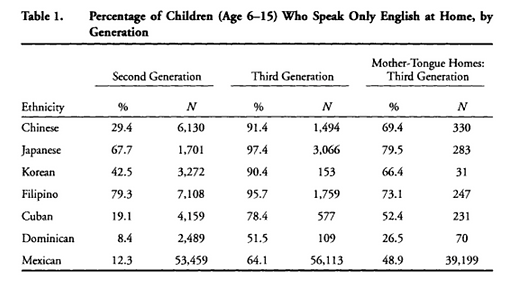
Percentage of Children Who Speak Only English at Home, by Generation
I find myself falling into this pattern being the second generation- growing up bilingual, but preferring to speak English even with my parents. Mandarin played a large part of my identity, shaping the relationships and dynamic within my family and how I present myself in front of friends, and I did not realize this until I lost most of the language. It is comforting to see that it is something that is common, but also upsetting that I did not do more to preserve the language.

Preservation
of mother tongue

"I am Terrified" by Shellie Zhang
Reclaiming the mother tongue is difficult, but being dedicated to learning it again, you are able to regain mastery of it.
"You ask me what I mean
by saying I have lost my tongue..."
Monika Schmid, leading researcher on language attrition at the University of Essex, states that if you still understand the language, but struggle to speak it is not a sign of the "first language eroding or being totally forgotten... it's still there and can be reactivated." The process of regaining a language is different for every individual- while some may just need to take classes to comprehend more complex grammar and vocabulary, others may need to completely immerse themselves by moving somewhere where that language is primarily spoken.
The speaker has to overcome the inhibitory mechanism that made English more dominant than the others, but there is evidence that "lost" first languages leave a permanent mark on the brain.It shows that the language we are born hearing, however young, has a strange way of staying with us. Actively trying to preserve your mother tongue involves a lot of intrinsic motivation. Whether that be through asking your parents to only speak to you in your native language or finding opportunities to study abroad to somewhere where that language is primarily spoken. I also feel that preserving the mother tongue is not only important in reclaiming a part of yourself, but also a way to stay connected to previous generations. This is why I find myself a lot more motivated to try and learn the language as not passing it on to further generations is something I fear, but it is also a way to reconnect with close and extended family in a different way.